

How to Use a Hair Color Wheel: A Simple Guide for Colorists
Every colorist has had that moment. You lift a client’s hair, rinse it out, and there it is: bright orange where you wanted a soft beige blonde. The good news is that you don’t need to guess your way out of it. The hair color wheel tells you exactly which tone will cancel the one you don’t want.
In this guide, we’ll keep things simple. You’ll learn how the hair color wheel works, how to read it, and how to use it with the tone numbers on a professional shade chart. By the end, you’ll know why ash fixes orange, why violet fixes yellow, and why some formulas turn muddy.
What Is a Hair Color Wheel?
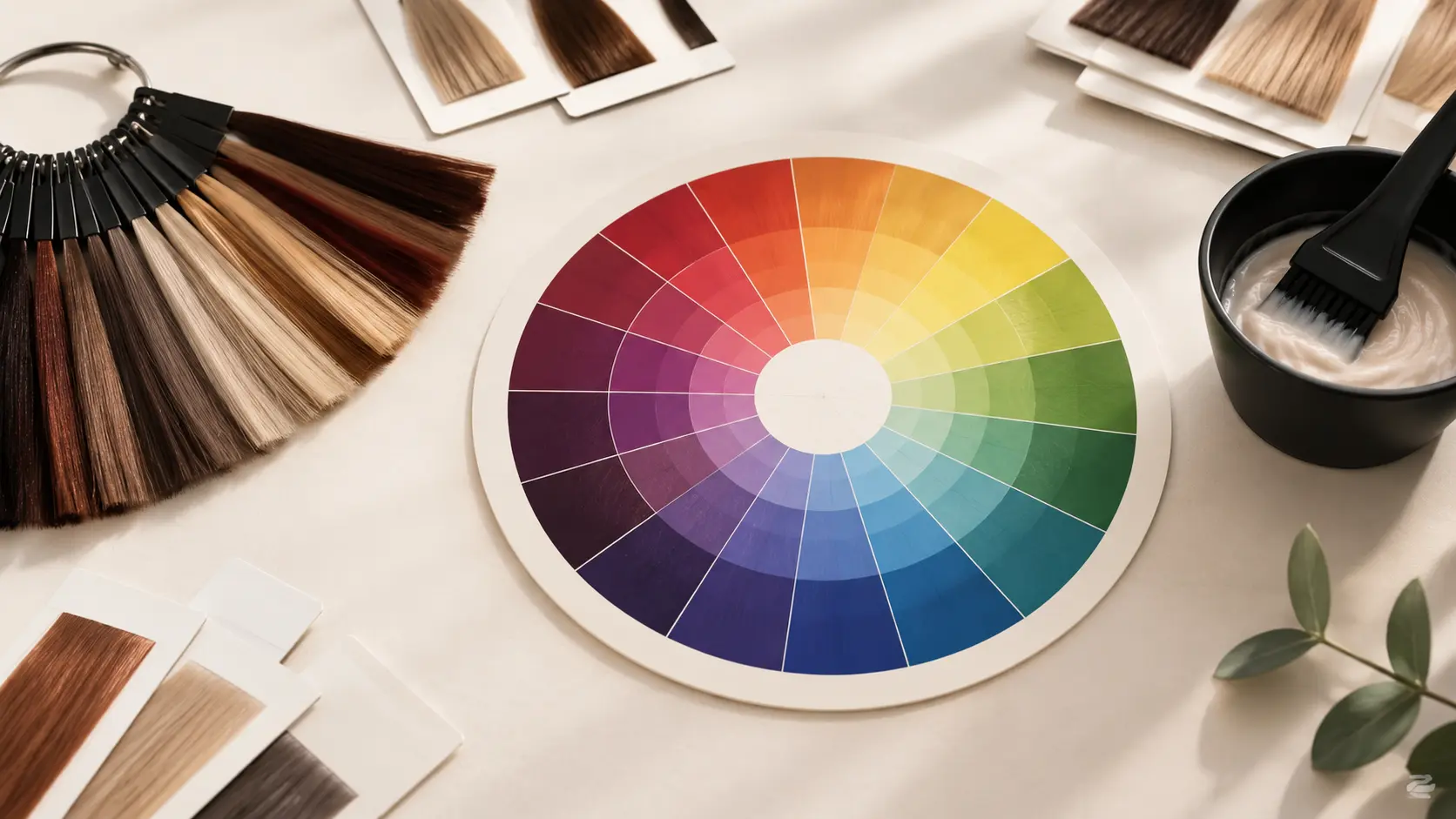
A hair color wheel is a circle that shows how colors relate to each other. It places each color next to its neighbors and directly across from its opposite. Colorists use it to plan formulas, correct unwanted tones and predict the final result before mixing anything.
It’s the same color theory artists learn in school. However, in hair color it has a very practical job. Hair always contains warm pigment underneath, and the wheel shows you how to control it. You can read more about the basic theory behind complementary colors if you want the science side.
The Three Groups of Colors on the Wheel
Primary colors
Red, yellow and blue are the primary colors. You can’t create them by mixing other colors. Every other shade on the wheel comes from these three.
In hair color, each primary plays a clear role. Blue is the strongest and darkest, so it adds depth and cools tones down. Red sits in the middle and adds warmth. Yellow is the weakest, and it gives brightness and light.
Secondary colors
When you mix two primaries in equal parts, you get a secondary color:
- Red + yellow = orange
- Yellow + blue = green
- Blue + red = violet
Tertiary colors
Next, mixing a primary with the secondary beside it gives you a tertiary color. Examples include red-orange, yellow-orange, blue-violet and blue-green. These are the in-between shades you see most often in real hair, especially during lightening.
How the Hair Color Wheel Works
The key idea is simple: colors opposite each other on the wheel cancel each other out. These pairs are called complementary colors. When you mix them, they neutralize into a soft brown or grey.
Here are the three pairs every colorist should know:
- Blue cancels orange
- Violet cancels yellow
- Green cancels red
So, if a client’s hair looks too orange, you add a blue-based tone. If it looks too yellow, you add violet. And if it looks too red, you add green. That’s really the whole system. Everything else is about using the right amount.
Why Hair Turns Orange or Yellow When You Lighten It
Natural hair holds warm pigment under its visible color. When you lighten hair, the darker pigment breaks down first. As a result, the warm pigment underneath starts to show.
Colorists call this the underlying pigment. It changes with each level:
- Levels 1–3: dark red to red-brown
- Levels 4–5: red to red-orange
- Level 6: orange
- Level 7: yellow-orange
- Level 8: yellow
- Levels 9–10: pale yellow
That’s why brassy hair is so common. For example, if you lift dark hair to level 7, you will see yellow-orange. The hair color wheel then tells you to use a blue-violet tone to calm it down. If you want a refresher on levels, our guide on how to read a hair color chart explains them step by step.
How to Use a Hair Color Wheel in Real Formulas
Knowing the theory is one thing. Using it at the chair is another. Follow these four steps.
1. Identify the current level and tone. Look at the hair under good light. Decide how light it is and which warm tone you can see.
2. Find the unwanted tone on the wheel. Is it orange, yellow or red? Locate it on the circle.
3. Choose the opposite tone. Look directly across the wheel. That’s your neutralizer.
4. Use it in the right amount. A little cancels the tone. Too much pushes the hair toward the opposite color. So start light and adjust.
Connecting the Hair Color Wheel to Shade Numbers
Here’s where the color wheel meets the hair color chart. On most professional shade charts, the number after the dot tells you the tone. Many brands follow a numbering system similar to this:
- .1 – Ash (blue base)
- .2 – Violet or iridescent
- .3 – Gold (yellow base)
- .4 – Copper (orange base)
- .5 – Mahogany (red-violet)
- .6 – Red
Now combine that with the wheel. Brassy orange at level 7? A 7.1 ash shade uses blue to cancel the orange. Yellow at level 9? A 9.2 or violet toner neutralizes it. Want to warm up a dull brown? Then you move the other way and add .3 gold or .4 copper.
Keep in mind that tone numbers can differ from brand to brand. Some brands use letters, like N for natural or A for ash, instead of numbers. That’s why it’s worth checking each brand’s own chart before mixing.
Using the Wheel to Add Warmth, Not Just Remove It
Most people think of the color wheel as a correction tool. In fact, it works just as well for creating color.
Neighboring colors on the wheel blend smoothly together. For instance, copper and gold sit close to each other, so a copper-gold shade looks rich and natural. Red and violet also sit side by side, which is why mahogany shades look deep and glossy.
On the other hand, mixing colors from opposite sides gives you neutral results. This is useful for natural browns and covering grey with a balanced tone.
Common Mistakes When Using a Hair Color Wheel
Even experienced colorists slip up sometimes. Watch out for these:
Overusing ash. Too much blue on light, porous hair can look grey, flat or even slightly green. Use just enough to cancel the warmth.
Expecting toner to lift. The color wheel cancels tone, but it doesn’t change the level. If hair is orange at level 6 and the client wants level 9, you need to lighten first.
Ignoring porosity. Damaged ends absorb pigment faster than the roots. So the same formula can look darker and cooler on the ends.
Forgetting the natural base. Warm underlying pigment is always there. If you skip it in your formula, the result will often turn out warmer than planned.
Mixing too many tones. Combining several opposite tones at once usually creates a muddy result. Keep your formula clear and purposeful.
Why Brands Add the Hair Color Wheel to Their Shade Charts
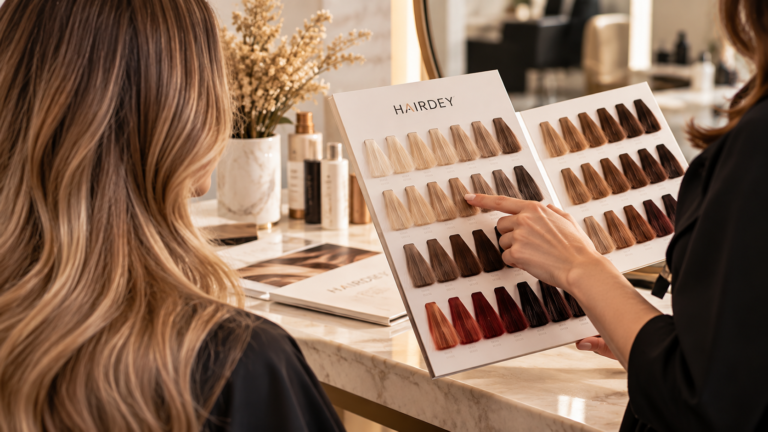
Many professional brands now print a hair color wheel or tone guide inside their shade charts. It makes sense. Colorists check the chart while formulating, so having the wheel right there saves time and reduces mistakes.
A good chart shows real hair swatches for every shade. A great one also explains the tone system clearly, so a colorist can move from a problem to a solution in seconds. We cover this in more detail in our post on how hair color charts help colorists.
At Hairdey, we design and produce custom hair color charts for hair color brands around the world. That includes shade cards, swatch books, circular charts and fully custom formats. We can also add your own color wheel, tone index or formulation guide to the design. If you’re planning a new chart for your brand, get in touch with our team and we’ll help you build it.
Hair Color Wheel FAQs
The hair color wheel shows how colors relate to each other. Colors that sit opposite each other cancel each other out, while colors that sit side by side blend together. Colorists use it to remove unwanted tones and to plan new shades.
Find the tone you want to remove, then look directly across the wheel. The color on the opposite side is the one that will neutralize it. For example, orange sits across from blue, so a blue-based ash shade cancels orange.
Blue cancels orange. That is why ash shades, usually marked .1 on a shade chart, are the go-to choice for brassy orange hair. For yellow brassiness, a violet toner works better.
No. The color wheel only helps you control tone, not level. A toner can cancel orange or yellow, but it cannot lift dark hair to a lighter level. You need to lighten the hair first, then tone it.
This usually happens when too much blue goes onto light, porous hair, especially hair with leftover yellow tones. Blue and yellow together create green. Using less ash, or a violet-based toner instead, helps avoid it.
Final Thoughts
The hair color wheel isn’t complicated once you see the pattern. Opposites cancel, neighbors blend, and the underlying pigment tells you what you’re working against. Pair the wheel with a clear shade chart, and formulating becomes faster, more predictable and far less stressful.
So next time you see unwanted orange or yellow, don’t panic. Just look across the wheel.

Planning a Hair Color Chart?
Send us your shade range and format, and we will come back with a sample proposal.